Hi readers! It has been far too long since I’ve posted a deeper cut, and for really no good reason – I’ve had the last two parts of my Anti-Blackness in Asia series finished for ages and just haven’t sent them out because of…inertia. I promise we’ll be getting back to that series soon, but I have something else to share first.
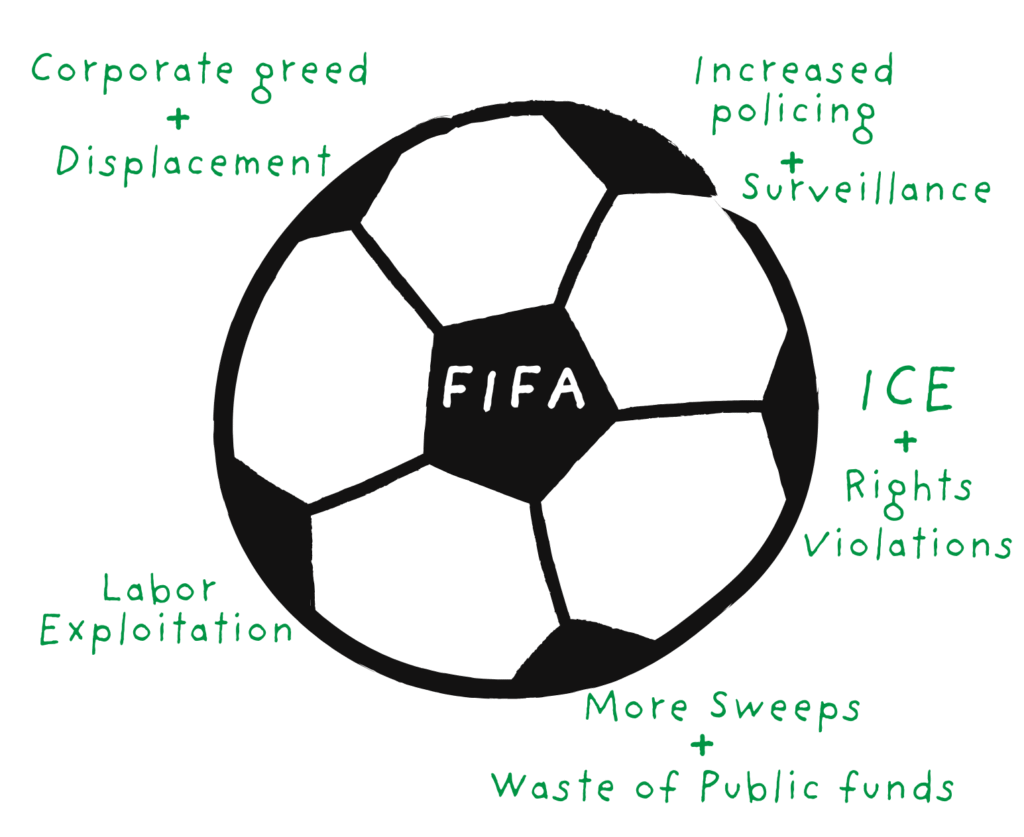
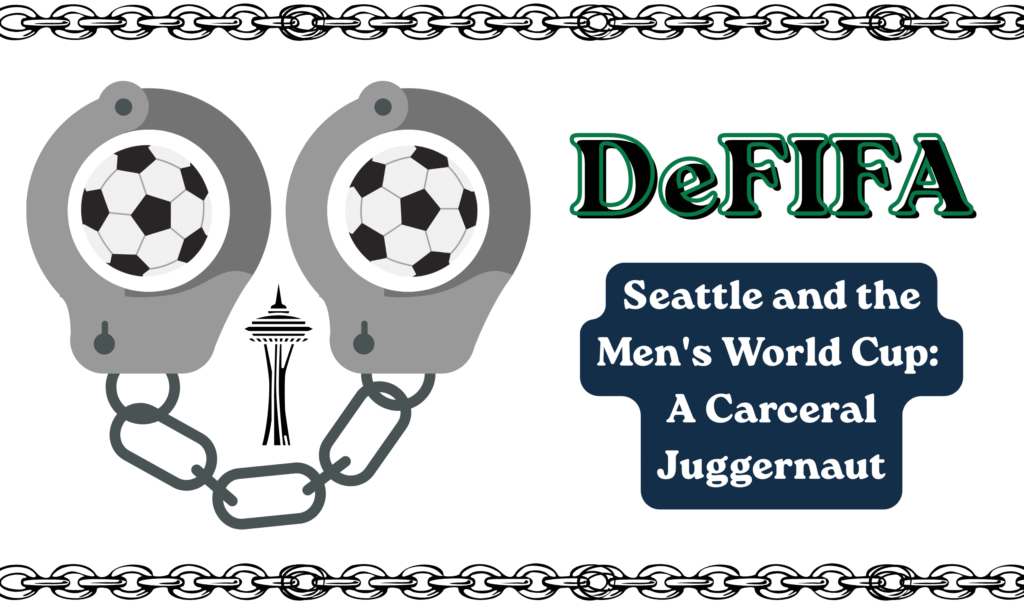
Today marks the first match of the 2026 FIFA Men’s World Cup (which my friends and I refer to as the MWC) that is being played in my hometown of Seattle. Since the MWC locations in the US were announced, I’ve been talking nonstop with my dear friends Leslie McCallum and Cameron Michels, fellow abolitionists and sports fans who also live and grew up in the area, about all the injustices that come along with the sporting event. Eventually, we decided to make a zine about it!
The zine focuses on the linkages between carcerality (that is, processes relating to the prison-industrial complex) and sports, specifically looking at stadiums and arenas as sites that replicate the harms of surveillance and punishment as dictated by our larger police state. While sports themselves mirror and enforce social hierarchies and often carcerality, our focus is on the uses of stadiums for confinement and the structural operations of power at sporting events. After illustrating these broader connections, we detail the mechanisms of surveillance and carceral logics at the upcoming MWC in known-to-settlers-as Seattle.
I’m sharing the first two sections of the zine today, and will be sending the other sections out regularly over the next five weeks. Each post will also repeat a section at the end with free actions you can take to address the harms of the MWC, including petitions to sign, events to attend, and resources that can help you learn more! And thanks to artists at Protect Our Pitch 206 for providing free protest artwork.
deeper cuts will never be monetized, but I believe that mutual aid is one of the ways we can build community and protect our own. if you like our writing, please click here to visit the mutual aid page and pick a campaign (or more than one) to donate to, and also take at least one of the easy actions listed at the end!
Sports and Carceral Systems are Already Intertwined
Throughout Roman times, gladiators, most of whom were enslaved people, were made to fight each other and animals as entertainment for the rich and powerful. The intersection of sport and punishment continues to modern day sporting spectacles and the policing of both athletes and fans, which will undoubtedly take place during the Federation of International Football Association (FIFA) Men’s World Cup being played in so-called North America throughout June and July 2026.
The modern specter of stadiums becoming prisons is a horrifying and blatant demonstration of the way these facilities can be utilized by the state to enact violence on the people. Some examples of this fucked up practice:
Following the 1973 Chilean coup d’état, the Estadio Nacional Julio Martínez Prádanos was horrifically turned into a prison where upwards of 20,000 people were incarcerated and hundreds murdered within the span of two months. The Estadio Nacional Sports Park is still in use today and has a memorial for the political prisoners.
In Manaus, Brazil, the capital of the Amazonas, there was a thankfully widely rejected and unrealized proposal by judge and prison system director Sabino Marques to use Arena da Amazônia, built for the 2014 World Cup, to detain people from the over-populated local prison.
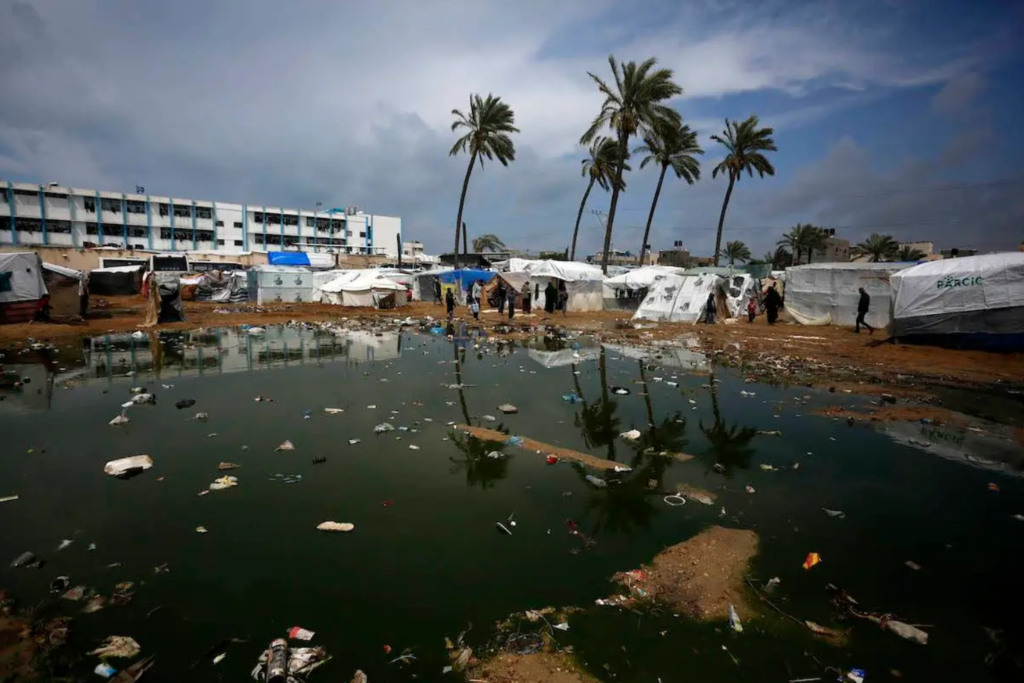
In the ongoing genocide of Palestinian people, the Israeli army turned Yarmouk Stadium into a detention and torture center in December 2023. Yarmouk Stadium in Gaza City is one of the oldest in Palestine and where many Olympic athletes have trained. The remains of the stadium, which Israel demolished in in January 2024, is now where thousands of displaced Palestinians are forced to reside in flimsy tents, where they are still terrorized by Israeli forces.
Following US Executive Order 9066 in 1942, there were fifteen “Civilian Assembly Centers” used for temporary detainment until larger, more remote concentration camps could be built to incarcerate over 120,000 Japanese Americans. Seven of these detention centers were located on converted horse tracks.
These instances of stadiums as prisons share a similarity to sports arenas becoming the sites of refugee camps and other types of displacement; notably, the Houston Astrodome following Hurricane Katrina in 2005 is another example of the state using the facilities for confinement that is beyond our current scope, but an intersection worth mentioning.
Surveillance and Detention Built into the Infrastructure
Modern sport is often a site for the celebration of toxic masculinity and violence. Sports fans are expected to get rowdy, consume alcohol, and be so passionate about their teams that they verbally and sometimes physically fight fans of the opposing team. This charged atmosphere is only intensified in the hyper-capitalist environment of the stadium featuring predatory advertising for things like gambling and alcohol. These elements are known to lower inhibition, yet punishment is the primary response to fans who do not manage their belligerence and rowdiness effectively. Some stadiums are built with holding cells, jail cells, and a few even have their own court! These systems of punishment are necessarily fueled by excessive surveillance. Here are a few examples of how these mechanisms become part of the fan experience:
At Borussia Dortmund’s Signal Iduna Park in Dortmund, Germany, there is a police station and two holding cells – one for away fans and one for BVB supporters – that each hold 130 people. In 2024, police at the park assaulted an opposing fan who was carrying a Palestinian flag. In February 2026, both BVB and Bayern Ultras united to protest against the police’s excessive force outside the stadium.
Veteran’s Stadium in Philadelphia, which hosted Eagles NFL games from 1971 to 2003, had both a courtroom and a jail. In response to a brawl in 1997, Eagles Court was created, a place where fans, most of whom were experiencing intoxication, were charged and fined. A storage room without ventilation, referred to as “The Sweat Box”, was turned into the holding cell, where fans would wait their turn to go in front of the Judge Seamus McCaffery. McCaffery seemed to revel in this role, complaining that the police were not arresting enough fans, and he ultimately built his political career on this bullshit. Eagles Court was located in the stadium for one year and then went to a police station, further cementing the formal carceral ties. 309 people were arrested in 2002 and 78 in 2003. Eagles Court ended in 2003 when the team moved to Lincoln Financial Field, but this current Eagle stadium still has a holding cell.
At least one of the stadiums where MWC games will be played, Texas’s AT&T Stadium, has a municipal court and holding cells in it! Opened in 2009, this stadium boasts a fully operational detention center, with holding cells, a courtroom where city of Arlington judges preside, and police ready to take people to jail. The (unproven) belief is that this swift processing of people and doling out punishment serves as a deterrent, increasing fan “safety”.
Recent reports exposed the troubling magnitude of surveillance that sports fans are subjected to while attending games at Madison Square Garden in New York City. The owner, James Dolan, has used facial recognition technology to deny entry to people with who he has personal grievances, and in an incredibly fucked up move, he used his “spy machine” to track a trans woman’s every move while she was attending Knicks games for over two years, despite the fact that she had committed no violations.
Another absurd example of the troubling entanglement of sport and incarceration: Stadium Lockup, a 2025 TV show on A&E, followed the “security” team at Cleveland Browns NFL games as they surveilled fans with approximately 500 cameras and issued punishments like ejecting fanst from the stadium and throwing fans in one of the four holding cells at this stadium. This voyeuristic show not only documents the connection between sport and incarceration, but also emphasizes the spectacle by creating entertainment for TV viewers. It, thankfully, had pretty trash ratings.
But what does all of this have to do with Seattle? Find out next time, where we discuss the carceral juggernaut that has been set into motion because of the MWC. Future posts will detail the larger context of how the MWC will disproportionately impact marginalized communities, security and surveillance theater within the stadium, and ways sports fans can approach community care instead of incarceration. We’ll eventually have a version of the full zine that is formatted to be printed at home if you also want to share it out in the community.
What You Can Do
Actions to Take
Sign petitions to protect Asian massage workers from ICE and police raids exacerbated by the MWC
Sign a petition to stand with Chinatowns across the country against displacement, surveillance, and policing made worse by the MWC
Attend a “Community Not Cameras” rally and press conference on Tuesday, July 7th from 1-2pm at Seattle City Plaza demanding that Seattle Mayor Katie Wilson turn off CCTV cameras in the Stadium District after the last MWC match
Watch a webinar bringing together advocates from Seattle, Los Angeles, Philadelphia, and Vancouver BC to discuss their activism against the harms of the MWC on Chinatowns
Use free art downloads about the MWC for non-commercial purposes to get the word out
Read a set of comprehensive community demands addressing surveillance, displacement, environmental and climate pollution, policing and incarceration, anti-immigrant violence, and other harms caused by the MWC
Organizations to Follow and Support
Protect Our Pitch 206 is a campaign and coalition encouraging all of our communities to come together in solidarity and protect Seattle from the negative impacts the FIFA World Cup brings. (IG: @protectourpitch206)
Massage Parlor Organizing Project is a grassroots formation of Asian/Asian American community members and workers organizing to build power among the migrant workforce in the Chinatown/International District (CID) and greater Seattle area. (IG: @mpop_sea)
CID Coalition brings together organizations that support growth, resources, equity, accessibility, and transit for the working class, immigrant, multiracial communities in Seattle’s CID. (IG: @humbows_not_hotels)
Puget Sound Sagecharts a path to a living economy in the South Salish Sea and Duwamish River Valley regions by developing community power to influence, lead and govern. (IG: @pugetsoundsage)
If we missed other organizations or collectives that are organizing and providing community care around the MWC in Seattle, email me at sivarajan [dot] deepa [at] gmail [com] and we’ll add them to the online version of this zine!
Subscribe for essays about climate justice, Palestinian liberation, Long COVID, prison & psych abolition, caste abolition & anti-Hindutva movements, women’s sports, and more